
The Intelligence Trap: Why People Make Dumb Mistakes" by David Robson
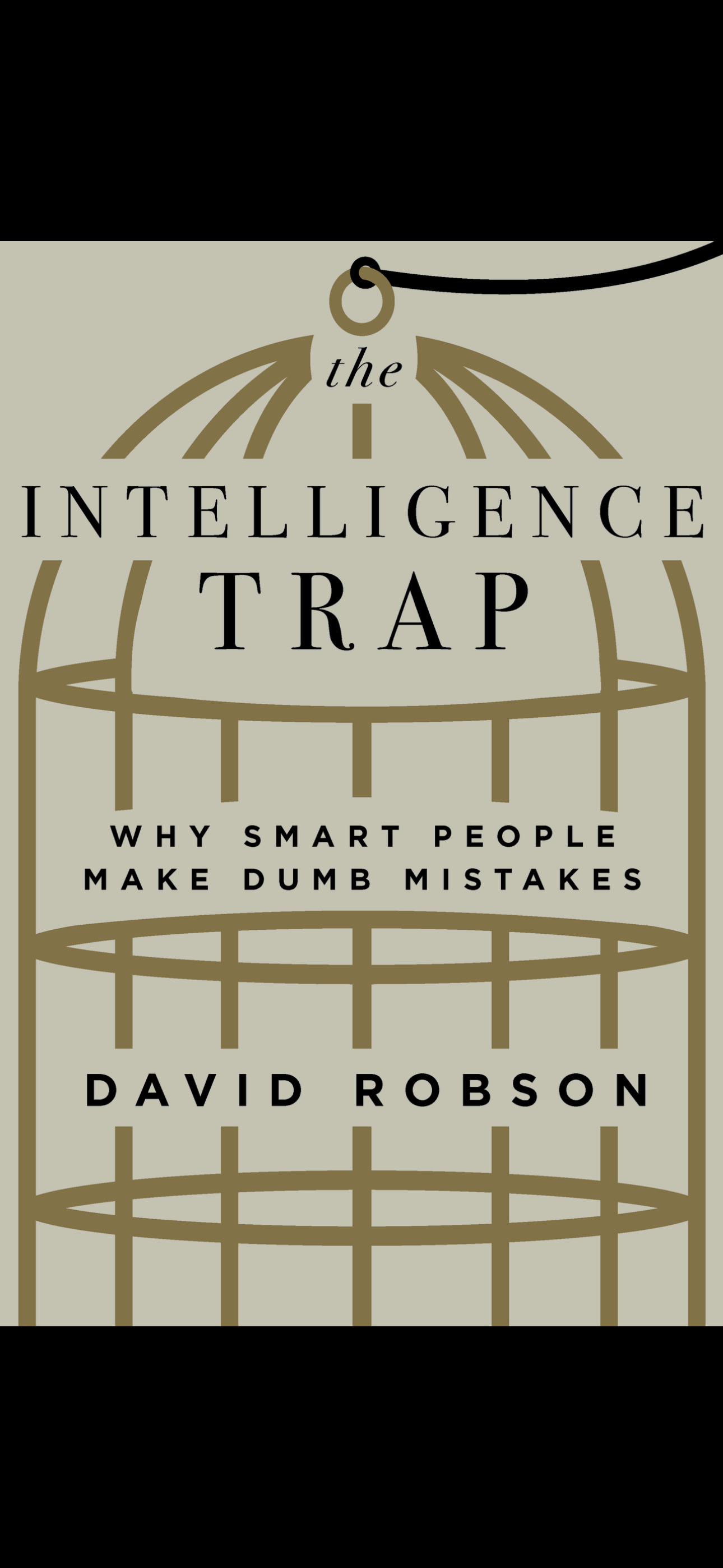
I heard about The Intelligence Trap on a YouTube video that recommended books worth reading. The subtitle caught my eye: “Why people make dumb mistakes.” It is available on Audible, so I listened to it, then went back to study the sections in my eBook version. I enjoy biographies, and the author promised to use famous historical figures to make his points. I was hooked.
Robson asserts that intelligent people are just as prone to make mistakes as someone with a lower I.Q. He argues that highly intelligent people can be even more prone to mistakes. He offers Arthur Conan Doyle, the brilliant author of the “Sherlock Holmes” series, as an example of how his intellect illustrates the complex process of deductive reasoning, prompting readers to rethink after encountering his description of Sherlock Holmes’ thought process. Yet, Conan Doyle could not use the same deductive reasoning in his own life, as he became sucked into the popular 1920s fad of speaking with the dead through seances and other forms of mysticism. Conan Doyle’s friend, Harry Houdini, shared his skepticism, driving the two men apart. Conan Doyle used his brilliance to create elaborate arguments to prove his flawed beliefs.
Intellect does not always coincide with intelligence. Robson quotes “Ray Hyman, a professor of psychology at the University of Oregon,” who confirms, “Conan Doyle used his intelligence and cleverness to discuss all counter-arguments…[He] was able to use his smartness to outsmart himself.” Yet, in addition to sharing Arthur Conan Doyle and several other figures, Robson also focuses on other ways intelligent people “make dumb mistakes.” Robson also provides skills and processes to prevent dumb mistakes.
Robson calls the reader to consider “evidence-based wisdom,” “self-reflection,” and “learning to recognize lies and misinformation.” Yet, even with tools, Robson confirms that intelligent people must regularly reflect on their decision-making and how to address challenges before they become disasters. Each chapter offers aha moments that guide readers to reflect humbly on their intellectual shortcomings. You will learn and enjoy Robson’s challenges. When you complete The Intelligence Trap, you will be thankful for the opportunity to stretch your mind, to reflect humbly in new ways, and to trust your actions.